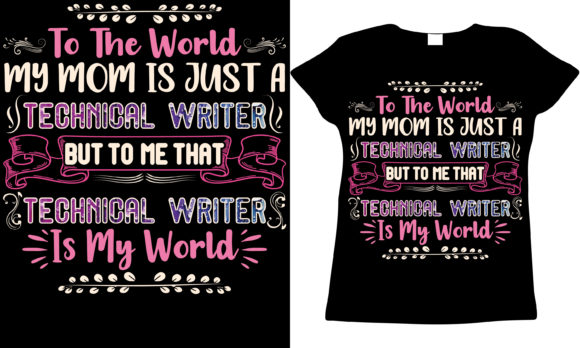
Review: Technical Writer Mom Mother's Day Shirt Design
As a designer who spends more time staring at stitch maps than most people spend on their phones, I approach every new machine embroidery design with a healthy dose of skepticism. We have all been there: you buy a cute graphic online, load it onto your machine, and halfway through the run, you realize the density is all wrong or the details are too tiny for the fabric you chose. That is why I took a close look at the Technical Writer Mom Mother s Day Shirt file set before committing it to a real client project. This isn't just about whether it looks good on a screen; it is about how it performs when the needle hits the cloth.
The first thing that struck me about this collection was its versatility. The package includes an EPS file at a massive 4500px by 5400px size, a transparent PNG at 300dpi, and an SVG. While these are technically Graphics intended for T-Shirt Designs, my mind immediately went to how I could adapt them for embroidery. The fact that these are unique vectors means the lines are clean and scalable, which is the foundation of a good digitizing job. If you are planning to digitize this yourself or send it to a digitizer, the source quality here is excellent. There is no pixelation to fight against, and the shapes are distinct enough to translate well into satin and fill stitches.
Real-World Application: The Boutique Sweatshirt Test
To truly evaluate this design, I imagined a specific scenario that many of us face in the spring: a last-minute order for a local tech company wanting personalized gifts for their remote employees' mothers. The brief was simple but demanding: something professional yet warm, suitable for a high-quality cotton blend sweatshirt. The Technical Writer Mom Mother s Day Shirt theme fit perfectly. It speaks directly to a niche audience—moms who juggle deadlines, documentation, and family life.
In this context, the design shines as a centerpiece for custom apparel. Because the vector art is crisp, it allows for clear definition even when scaled down for a left-chest logo or scaled up for a full-back statement. For a sweatshirt embroidery project, I would recommend using a heavier weight tear-away stabilizer to support the fabric's loopback texture. The design's layout suggests a balanced composition that wouldn't get lost in the fleece. When visualizing the finished product, I can see this working beautifully with a two-tone thread palette—perhaps a soft slate blue for the text and a contrasting coral for any graphical accents—to ensure readability without being overly loud.
Navigating Fabric Textures and Hoop Constraints
However, no design is one-size-fits-all, and practical judgment is required before you start stitching. If you are working with textured fabrics like waffle knits or heavy canvas tote bag design materials, you need to be careful with fine details. While the source files are high resolution, translating them into an embroidery file requires checking the stitch density. If the original graphic has very thin lines, they might need to be thickened slightly in your digitizing software to prevent breakage on stretchy materials.
I also considered how this would work on curved surfaces, like a baseball cap. Cap embroidery is notoriously tricky due to the limited hoop size and the curvature of the buckram. The Technical Writer Mom Mother s Day Shirt design appears to have a horizontal orientation that could fit well on a cap front, provided the text elements are large enough to remain legible. Small lettering is the enemy of curved stitching; if the design includes tiny fonts, you might need to simplify them or increase their height to avoid thread bunching. Always test on scrap fabric first. What looks perfect on a flat digital mockup can behave differently when pulled over a curved frame.
Enhancing Brand Value and Customer Trust
For Etsy sellers and owners of a small shop product line, the perceived value of your item often hinges on the clarity of the design. A blurry or poorly stitched graphic screams "amateur," whereas a crisp, well-executed embroidery job builds customer trust. This design asset offers a professional edge because it avoids the generic clip-art look. It feels bespoke. When a customer receives a personalized gift featuring this specific theme, they recognize the thoughtfulness behind it. It tells them you didn't just grab the first "Mom" graphic you found; you selected something relevant to their specific identity as a technical writer.
This level of specificity boosts buyer engagement. In a saturated market, niche designs win. Whether you are creating holiday embroidery gifts, baby embroidery for a shower, or commercial embroidery for corporate swag, the uniqueness of the vector art helps your brand stand out. It contributes to brand consistency if you are building a collection of profession-themed mother's day items. Furthermore, having access to the SVG and EPS means you can create high-quality printable mockups for your online listings before you even stitch a single thread, saving you time and material costs during the marketing phase.
Critical Designer Notes for Commercial Use
Before you list this as a handmade product or use it for commercial embroidery projects, there are a few housekeeping items to address. First, verify the licensing terms. The description states these are unique vectors with no stock photos, which is great for originality, but always confirm if the license covers physical goods for sale versus digital redistribution. Since the package provides EPS, PNG, and SVG, you likely need to digitize it for embroidery machines unless a specific embroidery format was included (which was not explicitly listed in the provided details).
Here is my checklist for moving forward with this design:
- Check Thread Colors: Map the vector colors to your actual thread chart. Ensure there is enough contrast between the thread and the garment color, especially if stitching on dark fabrics.
- Review Stitch Density: If digitizing, avoid overly dense fill stitches that can cause puckering on lighter fabrics like t-shirts.
- Test Stabilizers: Match your stabilizer to the fabric weight. Cut-away is usually safer for stretchy knits, while tear-away works for stable wovens.
- Inspect Small Details: Zoom in on the vector edges. Are there any stray points or jagged lines that need smoothing before digitizing?
- Mockup Verification: Create black and white versions of the design to ensure the shape holds up without relying on color contrast.
Ultimately, the Technical Writer Mom Mother s Day Shirt design is a strong contender for your spring inventory. It bridges the gap between a clever graphic tee concept and a tangible, high-quality embroidered item. With the right preparation regarding fabric choice, stabilizer selection, and digitizing tweaks, it has the potential to become a bestseller in your craft business. It respects the intelligence of the wearer while delivering the warmth of a handmade gesture. Just remember, the file is only as good as the execution, so take the time to test, tweak, and perfect your stitch-out. Your customers will notice the difference.